Mandalay Buddha Statues
A Mandalay Buddha statue is a Burmese sculpture associated with the artistic tradition of Mandalay in Myanmar. Collectors often recognise the broad robe folds, composed expression and carefully worked edges of the garment. The style includes seated and standing figures, ranging from plain carved surfaces to gilded lacquer with glass inlay. Start by comparing the posture and robe, then check which surface layers, fittings and repairs belong to the specific piece you are considering.
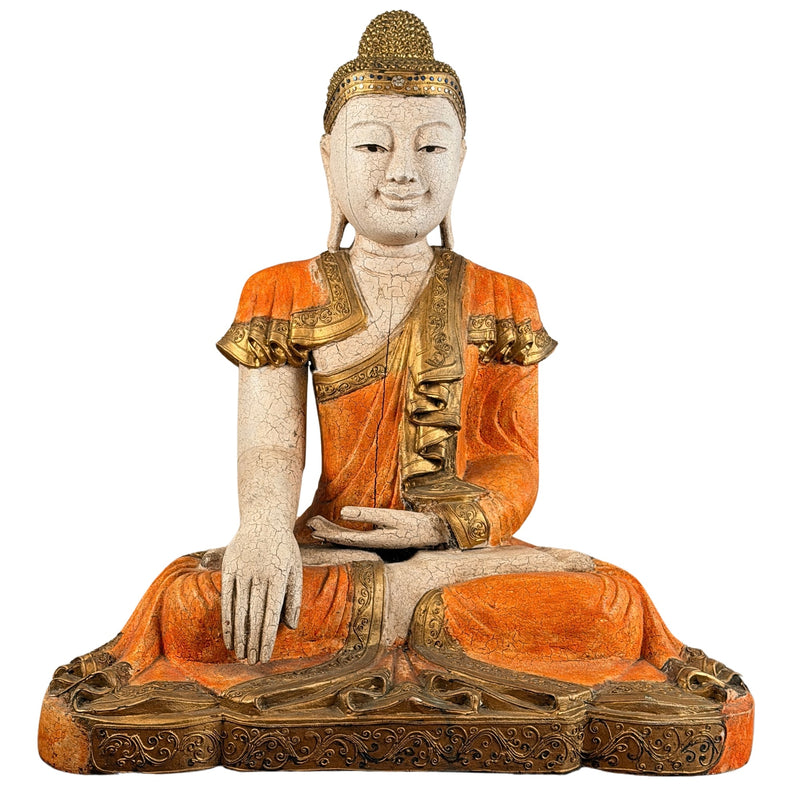
How to read the figure
On a seated Buddha, look first at the position of the right hand. In the earth-touching gesture, or bhumisparsha mudra, it reaches over the knee towards the ground while the left hand rests in the lap. The gesture recalls the Buddha calling the earth to witness his awakening. Standing figures can use different gestures or hold the robe, so read the arms and garment together.
The style takes its name from Mandalay, the last royal capital of Burma. A catalogue can describe a sculpture as Mandalay style while giving a later date or a broader Burmese origin. Treat the place, style and estimated period as separate pieces of information. When the history of ownership is documented, check whether the records concern the entire figure, the base or an earlier collection.
Gilt wood, lacquer and glass inlay
Study wooden examples in three-quarter light. This makes the carved robe folds legible and reveals how far the hands project. Lacquer can provide a ground for gilding or help build decorative detail. Glass inlay, where present, often catches the light along borders and bands. Look closely at the edges to understand how the individual pieces are set and whether any are loose or replaced.
Ask for a view of the back and underside. Tool marks, construction joins and the way the statue meets its base are useful parts of the examination. Our specialists examine surfaces under a microscope and with UV light, then interpret what they see alongside construction and style. We give the period as an expert estimate and describe visible treatment or repairs when the evidence supports them.
Compare the workmanship with our collection of Asian wood carvings, where carving, paint and gilding can be seen on different types of objects. The Indonesian art and antiques collection also provides a regional comparison for temple carving, bases and decorative detail across Southeast Asia.
Choose a Mandalay Buddha for display
- For a quiet, frontal arrangement. Consider a seated figure with a stable base. Look for enough depth to see the knees and enough width to keep the robe clear of furniture edges.
- For a tall display. Compare standing figures and measure the combined height of the sculpture and plinth. Check how the base attaches and ask for the footprint and weight before arranging delivery.
- For a collection focused on surface. Choose side lighting that reveals lacquer, pigment and glass without direct sun. Look at close views of the face, robe border and joints to decide which wear you are comfortable with.
The 85 cm Burmese Mandalay Buddha in gilt wood illustrates how a broad robe and painted face can hold a room from a distance. Check its listing for current availability and inspect the close views of the face and headband. For further examples, browse the Burmese Buddha statue collection.
Before choosing a plinth, check whether the statue has an integral base, a separate stand or a later mounting block. Ask for a photograph of the underside. This helps you plan how the weight will rest on the support and how much clearance the carved robe needs.
Condition and handling
Ask whether cracks run across a join or through the base, and whether any lifting paint or lacquer needs stabilisation. Minor wear on projecting edges often has different implications from movement at a wrist or ankle. Good photographs should let you locate each condition point, so you can understand what it means for display and handling before you buy.
Keep gilt and painted wood indoors at a stable temperature, away from direct heat and damp. Support the statue at its base when moving it and keep pressure off the hands and folds. Ask a conservator about loose inlay or lifting surface layers before attempting to clean them. A large figure deserves a clear route from the delivery point to its permanent position.
Frequently asked questions
What distinguishes a Mandalay Buddha statue?
Collectors usually look at the robe, facial modelling and treatment of the surface together. The attribution also considers posture, construction and comparisons with documented examples of Burmese sculpture.
Are all Mandalay Buddha statues gilded?
Finishes vary. Some examples combine gold, lacquer, paint and glass, while others show a more restrained surface. The object’s listing should specify the finish observed on that particular statue.
Does Mandalay style give the exact date of a sculpture?
Style identifies a visual tradition. The estimated period depends on physical examination, construction, comparative examples and any reliable documents tied to the piece.
How can I compare seated and standing Mandalay figures?
Compare the hands, drapery and base first. Then measure your display area. A seated figure typically uses more width, while a standing one brings the height and stability of the mount into focus.
Can I request photographs before buying?
Yes. Contact the gallery with the object link and tell us what you want to see, such as the base, a robe edge, the rear surface or a particular join.