
Look closely at a piece of Thai sculpture and you'll see more than fine craftsmanship. Behind the serene faces and graceful postures of Buddha statues lies a history spanning nearly two thousand years. Over that time, influences from India, the Mon kingdom, the Khmer empire, and Sri Lanka came together.
As a result, the sculpture of Thailand has developed into a unique and instantly recognizable tradition. In this article, we take you through the most important periods of Thai sculpture. We then show how a Thai temple, known as a wat, is laid out.
The Roots of the Sculpture of Thailand
The Influence of India's Gupta Tradition
Like other countries in the region, Thailand came under the influence of India's Gupta tradition at an early stage. This influence is clearly visible in the country's art and culture. The earliest antique Buddhist art in Thailand was therefore created in this Indian style.
The Role of the Mon Kingdom
Later, the Mon kingdom in present-day Myanmar extended its influence to the surrounding regions. According to historical records, the Mon converted to Buddhism around 200 BCE. Along with their conversion, they also adopted the art and culture that came with it.
The Mon created numerous Buddhist works of art and gradually adapted the style to their own culture and community. This gave rise to a new and distinctive art form. As the kingdom grew, this style also spread into Thailand.

Between the 1st and 7th centuries, many works based on the Gupta tradition and Mon art were created, including:
-
statues and other sculptures
-
murals
-
architectural structures
From Mahayana to Theravada: The Development of Thai Sculpture
Khmer and Srivijaya Art and Mahayana Buddhism (9th Century)
In the 9th century, the influence of the Gupta tradition and the Mon kingdom began to fade. In the north, Cambodian Khmer art took hold, while Srivijaya art rose in the south.
Both styles were rooted in Mahayana Buddhism. They can be recognized by the striking fluidity of their expression. Thematically, the focus was on the Mahayana pantheon, with numerous depictions of bodhisattvas.
Sukhothai and the Arrival of Theravada Buddhism (13th Century)
In the 13th century, Theravada Buddhism reached Thailand from Sri Lanka. King Ramkhamhaeng of Sukhothai played a key role in spreading it. He invited senior monks from Sri Lanka to teach their understanding of Buddhism in Thailand.
During this period, the ethnic Thai kingdom helped shape a new form of Buddhist art characterized by highly stylized images. Alongside the conventional style, geometric and almost abstract figures were also created.
Ayutthaya: Splendor and Refinement (14th–18th Centuries)
During the Ayutthaya period, another distinct style emerged. Buddha statues were depicted in an even more stylized manner and adorned with luxurious garments and jeweled ornaments.
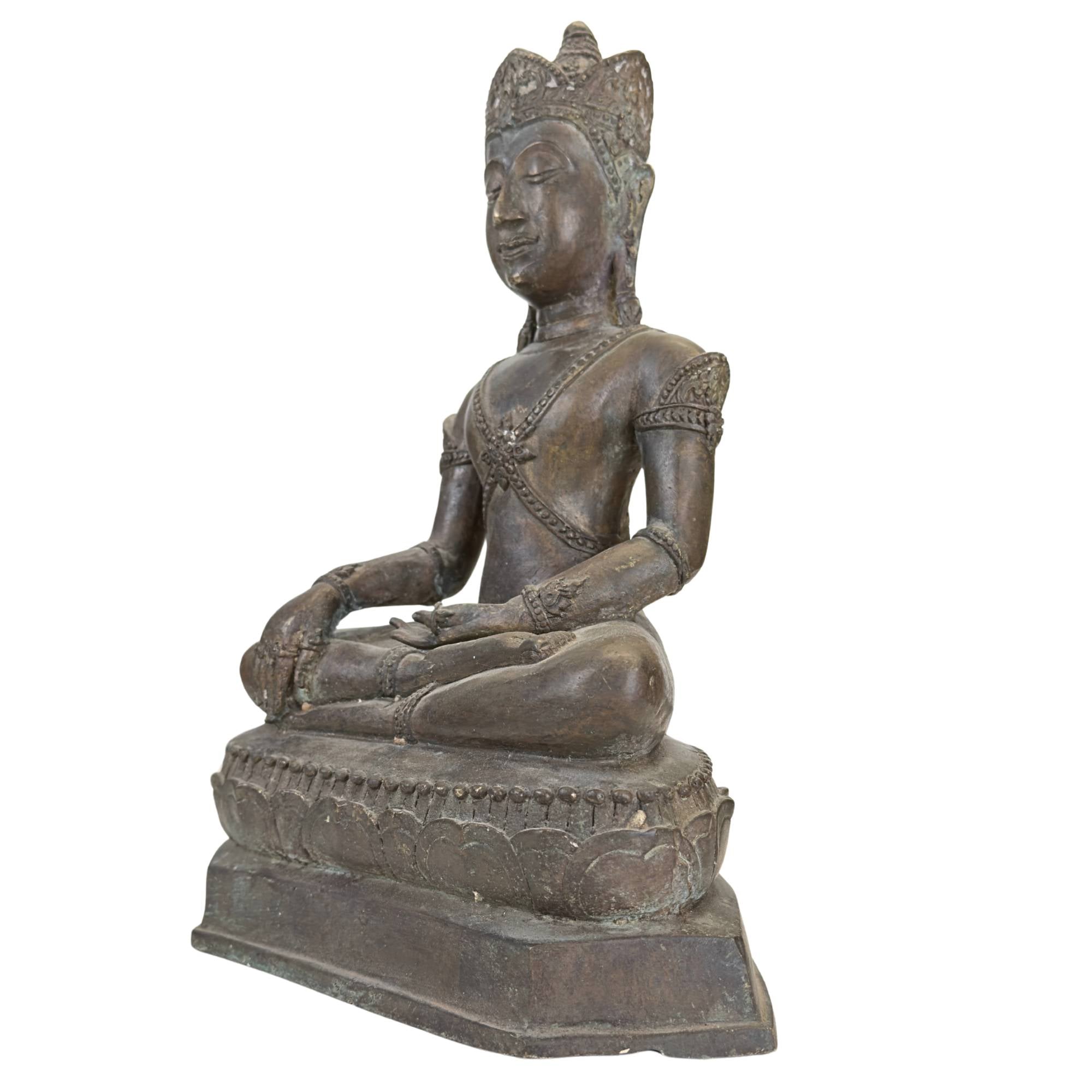
This explains why many Thai Buddha statues and temples are gilded and occasionally enriched with inlays.
Thonburi and Rattanakosin: Bangkok as the Royal Center
Under the Thonburi and Rattanakosin kingdoms, Thai Buddhist art continued to develop. When Bangkok became the royal center of the kingdom of Siam, Buddhist monuments rose across the country, from temples to large Buddha statues.
These structures served a dual purpose:
-
expressing religious devotion
-
showcasing the authority of the rulers
Curious to see what these styles look like in real life? In the 1stBuddha gallery, you can explore our collection of Buddha statues and works of art at your leisure.
Buddhist Arts and Architecture of the Thai Wat
A Buddhist temple in Thailand is not a single building but a complex of structures, each with its own purpose. Its layout follows two architectural forms: Phutthawat and Sangkhawat.
Phutthawat: The Buildings Dedicated to the Buddha
The Phutthawat contains several buildings, each with a distinctive design:
-
Chedi: a bell-shaped stupa with a relic chamber.
-
Prang: the Thai version of the Khmer temple tower.
-
Ubosot: the hall regarded as the most sacred area of the wat.
-
Wihan: a shrine hall housing Buddha statues, also used as an assembly hall where people pray.
-
Mondop: a shrine with a spired roof within the temple compound.
-
Ho trai: the Buddhist library.
-
Sala: an open pavilion offering shade and a place to rest.
-
Sala kan parian: a large hall for study and afternoon prayers.
-
Ho rakhang: the bell tower.
Sangkhawat: The Monks' Living Quarters
The Sangkhawat is where the monks' living quarters are located. It also includes other buildings, such as the ho rakhang (bell tower) and the sala kan parian (study hall).
In the past, the monks' quarters were small structures built on stilts. Today, monks often live in a modern apartment building with small rooms.
Thailand Today: Where Antique and New Art Meet
Today, Thailand is best known for Theravada Buddhism. The country is regarded as one of the most important destinations for Buddhist pilgrims.
This is partly because Thailand carefully preserves its antique Buddhist art. At the same time, new Buddha statues are still being created, keeping the tradition very much alive.
Conclusion
The sculpture of Thailand is the result of centuries of exchange between cultures and religious movements. From the early Gupta and Mon influences, through the Mahayana Buddhism of the Khmer and Srivijaya, to the stylized Sukhothai figures and the gilded splendor of Ayutthaya, every era has left its own mark.
The architecture of the Thai wat reflects this rich history as well. Each building has a clear function, from the relic chamber in the chedi to the monks' living quarters. Once you understand Thai sculpture, you will see every statue and every temple through new eyes.
Contact Us
Are you looking for a piece of Thai sculpture for your home, meditation space, or collection? Or would you like to learn more about the background of our Buddha statues? Contact us at 1stBuddha. We're happy to advise you and help you find the statue that's right for you.


