
Buddhism is known as a spiritual path without an all-powerful creator. Yet this centuries-old tradition has a rich world of enlightened beings, gods and goddesses. Think of The Buddha himself and The Taras, the beloved female deities of love and compassion.
Anyone who explores the deities of Buddhism soon discovers that these figures mean something quite different from gods in other religions. In this article, you will learn who the most important deities are, what they symbolize and how to recognize them in statues, thangkas and other Buddhist art.
Buddhism Gods: Are There Really Gods in Buddhism?
Anyone searching online for Buddhism gods might expect a divine world like the ones we know from Greek or Roman mythology. Buddhism works differently. In general, its teachings do not include belief in multiple gods who rule over the world.
Gods as Fortunate but Temporary Beings
According to Buddhist teachings, gods, also called devas, are fortunate beings rather than all-powerful rulers. They possess more powers and abilities than ordinary humans, but those powers are limited.

Key characteristics of gods in Buddhism:
- Thanks to their supernatural abilities, they live much longer than humans.
- They live in happier realms, where life is more pleasant and luxurious.
- Like humans, they are subject to karma.
- They, too, are part of the cycle of birth and death (samsara).
Devas remain within samsara. They should be distinguished from Buddhas and bodhisattvas, whose images concern awakening, wisdom and compassion. These different categories are often grouped under the broad expression “Buddhist deities”, but they do not have the same religious status.
How Different Traditions View the Gods
Not every tradition answers the question of a god in Buddhism in the same way. Theravada Buddhism is largely non-theistic, but it does not deny the existence of divine beings.
In Mahayana and Vajrayana Buddhism, however, deities hold a prominent place. Mahayana Buddhism in particular has strongly shaped the Buddhist art surrounding these figures.
Peaceful and Wrathful Deities
A striking group in Buddhist art is the so-called wrathful deities. These are fierce, powerful manifestations of bodhisattvas, who are normally depicted as peaceful figures. You will see them especially in Tibetan Buddha statues and other Tibetan art.
The Most Important Buddhist Deities at a Glance
The most popular deities in Buddhism include the Buddha himself, the Laughing Buddha, the Green and White Taras and Avalokiteshvara. Below, we introduce the most important figures.
The Buddha: The Highest Status
Within Buddhism, the category of Buddha holds the highest status. Notably, "Buddha" is never used as a name. It is a title, a term of respect.
The historical Buddha, Gautama Buddha, lived around 500 BC and is revered throughout the world. His image holds a central place in Buddhist art. Besides him, the tradition recognizes other Buddhas, including:
- Dipankara Buddha
- the Five Dhyani Buddhas
- the Medicine Buddha
Avalokiteshvara: The Most Versatile Bodhisattva
Avalokiteshvara, known in Chinese as Guanyin, has more forms than any other Buddhist deity. After the Buddha himself, he is the most beloved figure in Buddhism.
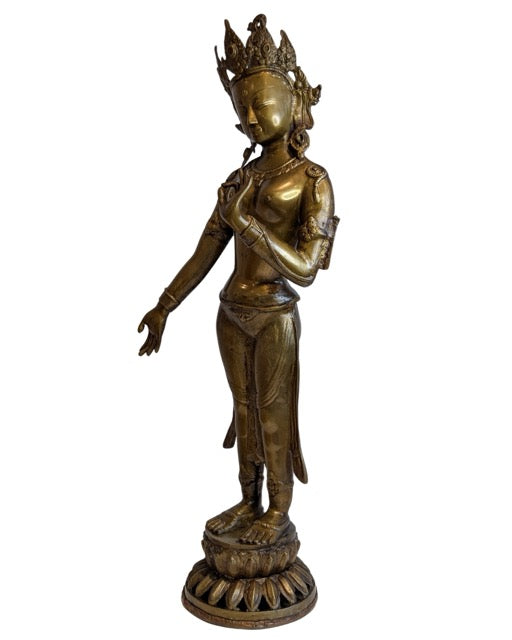
He is known from the very earliest period of Mahayana teachings. From India, his worship spread to Southeast Asia, where it met with great success, as well as to Nepal and Tibet. Each of these countries developed its own version of Avalokiteshvara, with its own style of depiction.
Manjushri: The Bodhisattva of Insight
Manjushri is the bodhisattva of insight and intuition. His name means "the noble and gentle one." He is especially revered in Vajrayana Buddhism and is popular in Tibet and Nepal.
In statues and artwork, Manjushri usually appears as a pure, innocent young man. He rests on a lotus or rides a fierce lion. His recognizable attributes are:
- a sword that cuts through ignorance and opens the way to liberation;
- a scroll representing the sacred Prajnaparamita text.
Tara: Buddhist Goddess of Compassion
Tara embodies enlightened compassion and protective activity. In Tibetan Buddhist traditions she appears in female form for the benefit of beings. Her sacred role differs from the idea of an all-powerful creator.
The familiar seated Green Tara has one leg folded and the right leg extended. White Tara is associated with longevity; her well-known seven-eyed form has additional eyes on the forehead, palms and soles. Historical sculpture also includes standing Taras, so posture must be read with the hands and surviving attributes.
For the full comparison of Green and White Tara, the seven eyes, lotus attributes, standing forms and museum examples, read our Tara statue meaning and identification guide. To explore objects in the gallery, visit our Tara statues collection.
Prajnaparamita: The Perfection of Wisdom in Buddhist Art
Prajnaparamita names the perfection of wisdom in Mahayana Buddhism and the texts that expound it. In sculpture and painting, that wisdom also takes the form of a sacred figure. The distinction matters: an image of Prajnaparamita personifies Buddhist teaching, while a Prajnaparamita manuscript contains that teaching.
A manuscript or book is an important identifying attribute. The Met’s Nepalese cover for an Ashtasahasrika Prajnaparamita Sutra places the goddess at the centre with the text in a raised hand. This is a documented example of the relationship between the deity and the scripture.
Her hands and attributes vary with the form represented. In a western Tibetan manuscript painting dated to the eleventh–twelfth century, Prajnaparamita makes the teaching gesture associated with turning the Dharma wheel. A fourteenth-century Japanese Hannya mandala presents her holding a scripture, attended by Brahma and Indra.
For collectors, a book, teaching gesture and complete composition are more useful than a general resemblance to another crowned figure. Missing attributes, later repairs and regional conventions must be read together. Prajnaparamita and Manjushri both embody wisdom and can share the book attribute; the complete iconography establishes which form is represented. Our mudra guide explains the hands, while our Nepalese sculpture collection introduces the Newar artistic setting.
Yaksha and Yakshi: Nature Spirits in Buddhist Art
Yaksha and yakshi are male and female nature spirits in South Asian religious art. They belong to a different category from enlightened Buddhas and bodhisattvas. Their inclusion in Buddhist monuments reflects the wider sacred world surrounding the Buddha.
The Met’s study of early South Asian nature deities explains how tree spirits, fertility imagery and auspicious figures entered Buddhist visual narratives. A yakshi associated with a flowering tree can appear on a temple or stupa gateway; a female figure with jewellery alone is not enough to establish that identity.
When examining a Himalayan bronze, identify the surviving attributes, pose and original setting before applying the name yakshi. An early Indian architectural example provides context, but does not establish the age, region or identity of an unrelated Himalayan sculpture.
Ushnishavijaya: Buddhist Goddess of Long Life
Ushnishavijaya, also written Usnisavijaya, is a female Buddhist deity associated with longevity. In Tibetan Buddhist art she belongs to the Three Long Life Deities alongside Amitayus and White Tara, as explained by Himalayan Art Resources. This is a distinct iconographic group within the wider Buddhist pantheon.
Her familiar form has three faces and eight arms. The implements are important: a small seated Buddha, bow and arrow, vajra and covered vase help identify the figure. The Metropolitan Museum of Art’s Qing-period Ushnishavijaya illustrates this arrangement and the connections between Tibetan, Mongolian and Chinese Buddhist sculpture.
Ushnishavijaya and White Tara share an association with long life, but they are separate figures. Read the complete combination of faces, arms and surviving attributes before assigning an identity. The iconography identifies the deity; the sculpture’s manufacture, style and documented history establish its regional attribution and estimated date. Explore our Tibetan Buddhist sculpture for related collecting traditions.
Yab-Yum: The Tantric Union of Wisdom and Compassion
Yab-yum is a Tibetan term meaning “father-mother”. In Vajrayana Buddhist sculpture and painting, it describes a deity represented in embrace with a consort. The paired figures express the union of wisdom and compassionate method on the path to awakening. The Rubin Museum’s explanation of tantric consorts sets out this symbolism.
The male figure conventionally represents method or active compassion, while the female figure represents wisdom. Their embrace presents these qualities as inseparable. As the Smithsonian’s glossary of Himalayan Buddhist art explains, such divine couples also belong to tantric visualization practices.
Yab-yum describes the relationship between the figures, rather than naming one particular deity. To identify a sculpture, read its faces, hands, implements, posture and consort together. For collectors, that iconographic identification is considered alongside the object’s casting, surface, condition and documented history when assessing its regional origin and estimated date. Explore our Tibetan Buddhist statues and thangka paintings for the wider artistic tradition.
Other Well-Known Buddhist Deities
Besides the figures mentioned above, Buddhism recognizes many other deities. Some well-known names include:
- Yama, the god of death
- Mahakala, "the great black one"
- Kubera, the god of wealth
- Palden Lhamo, a protective goddess revered especially in Tibet
- Brahma, a deity also known from Hinduism
Buddhist Deities Statues: The Meaning Behind the Figures
Buddhist deities statues are much more than decorative objects. A good statue, and especially an antique piece, carries within it the essence of what the deity represents in Buddhism.
Symbolism You Can Learn to Recognize
Every posture and every attribute has a meaning. If you know what to look for, you can read a statue almost like a story: Tara's lotus, Manjushri's lion and sword, or the many forms of Avalokiteshvara.
Choosing a Statue That Suits You
For anyone who feels a connection with Buddha and Buddhism, a deity statue can have a meaningful place in the home or in a meditation space. Let the meaning guide your choice:
- The Buddha: enlightenment and inner peace
- Avalokiteshvara: compassion
- Manjushri: insight and intuition
- Green Tara: active compassion and protection
- White Tara: compassionate longevity
In the 1stBuddha online shop, you will find Buddha statues and figures of various Buddhist deities, each with its own story and symbolism.
Conclusion
Buddhist art brings together figures with different religious roles. Devas remain within samsara, while Buddhas and bodhisattvas embody awakening and the path towards it. Reading the posture, hands and attributes allows us to distinguish those roles and identify the particular form represented.
Their statues make this wisdom and compassion truly tangible. Would you like to explore this rich tradition further, or are you looking for a statue with a special meaning? At 1stBuddha, we are happy to help.
Contact us
Do you have questions about a specific deity, the symbolism of a statue or the 1stBuddha collection? Feel free to get in touch. We are happy to advise you and help you find the statue that truly suits you.


